How Horror Movie Marketing Preys on our Fear…of Missing Out
Ever since William Friedkin unleashed The Exorcist on unsuspecting moviegoers in 1973, horror movie marketing and the fear of missing out have gone hand in hand.
Audiences lined up to see what was so frightening about the demonic possession film and turned it into one of the biggest R-rated hits of all time. Reactions to the film notoriously included viewers who passed out, vomited, and even suffered a heart attack in one alleged instance.
Knowing they were in the middle of a cultural moment, studio executives utilized the uproar to drum up even more controversy and, thus, interest in the film. Ads for the movie showed viewers squirming in their seats. Today, 'Audience Reaction' trailers are commonplace for horror movies. Paranormal Activity deployed a similar marketing strategy, using an audience reaction trailer to introduce the found-footage horror film. The trailer quickly went viral, and the film, made for just $15,000, went on to gross nearly $200 million worldwide and launched a franchise with seven films since 2009.
But why is this important?
You may have heard that the rom-com is dead. Studios have all but stopped financing original, mid-budget movie ideas aimed at adults, too. The truth is movies cost a lot to produce and market, and without guaranteed financial returns, most studios aren't willing to risk distributing a potential flop. Many of these movies have ended up on streaming services or go direct to video-on-demand to make way for blockbusters and superhero tentpoles.
That is unless you're a horror movie.
Amidst Disney & Marvel's never-ending slate of superhero behemoths, Paramount's Top Gun: Maverick and Universal Picture's Jurassic World: Dominion, 2022 was filled with the little horror movies that could. But instead of flashy, big-budget marketing campaigns, the horror films released this year got clever with their advertising.
On September 26, Paramount launched a creepy and effective guerilla marketing tactic for its film, Smile, by placing a series of actors in crowds at various baseball games that aired during primetime. The actors were directed to smile...for the entire game. The imagery mimicked the poster for the movie, which follows a curse that appears to its victims as a smiling intruder. Viewers turned to the internet for answers during the game and could watch the full trailer for the movie out September 30.
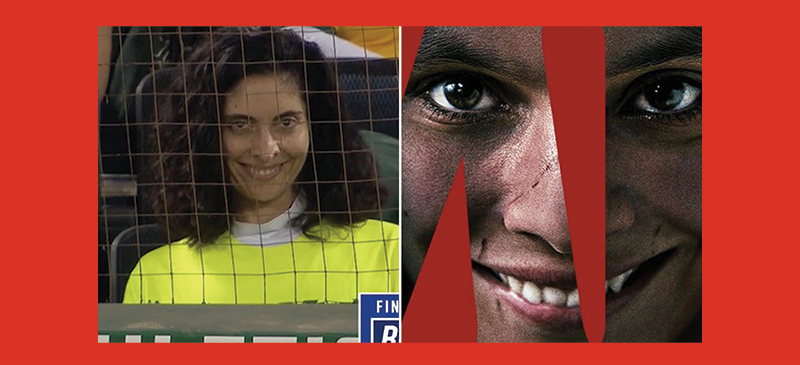
An actor was hired to attend a primetime baseball game and paid to smile directly into the camera for the game’s duration to promote the 2022 horror film, Smile.
The studio could have spent millions of dollars on TV spots or other in-game promotions. But they earned more impressions than any paid advertising could buy for only a few hundred bucks. The bet paid off, too. Smile, made for only $17 million, went on to gross $216 million worldwide.
Another studio that's no stranger to micro-budgeted horror is Blumhouse Productions. In October, they kicked off promotions for M3GAN, a horror film about an evil ai-controlled doll, by releasing a simple teaser trailer. In it, M3GAN is seen dancing in an unsettling manner. The short clip instantly went viral as a TikTok trend; by Halloween, M3GAN was a must-have costume. Even Jason Blum, Founder of Blumhouse, got in on the joke and dressed up as her for the holiday.
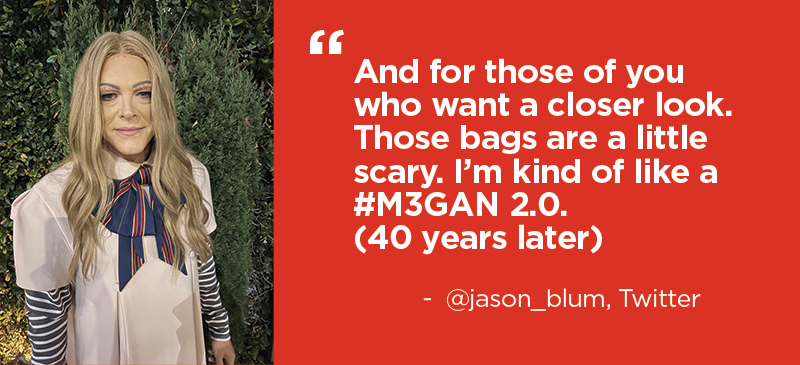
An image from Jason Blum, Founder of Blumhouse Productions, dressed as the titular doll from his new horror film, M3GAN, for Halloween.
M3GAN's marketing team capitalized on the dance's popularity by recreating it at the film's premiere. In a moment of serendipitous Internet synergy that marketers can hardly dream of, eight performers dressed as identical M3GAN dolls danced to Taylor Swift's It's Nice to Have a Friend on the black carpet. A clip of the performance has nearly 4 million views on Twitter.
M3GAN releases the first weekend of January, up against Avatar: The Way of Water's fourth weekend. While it won't dethrone James Cameron's CGI extravaganza, the $12 million-budgeted movie is expected to bring in north of $20 million in its first weekend, charting a clear path to profitability.
Smile and M3GAN have carried on with the tradition of unique marketing tactics, banking on audience FOMO, from which horror movies have benefitted for decades. These low-cost, viral stunts resulted in millions of impressions, promoted the communal aspect vital to horror movie viewing, and translated into tickets sold.